Heat Stress at Work: How to Manage Hot Weather, PPE and Worker Safety
By Pujan Thakkar
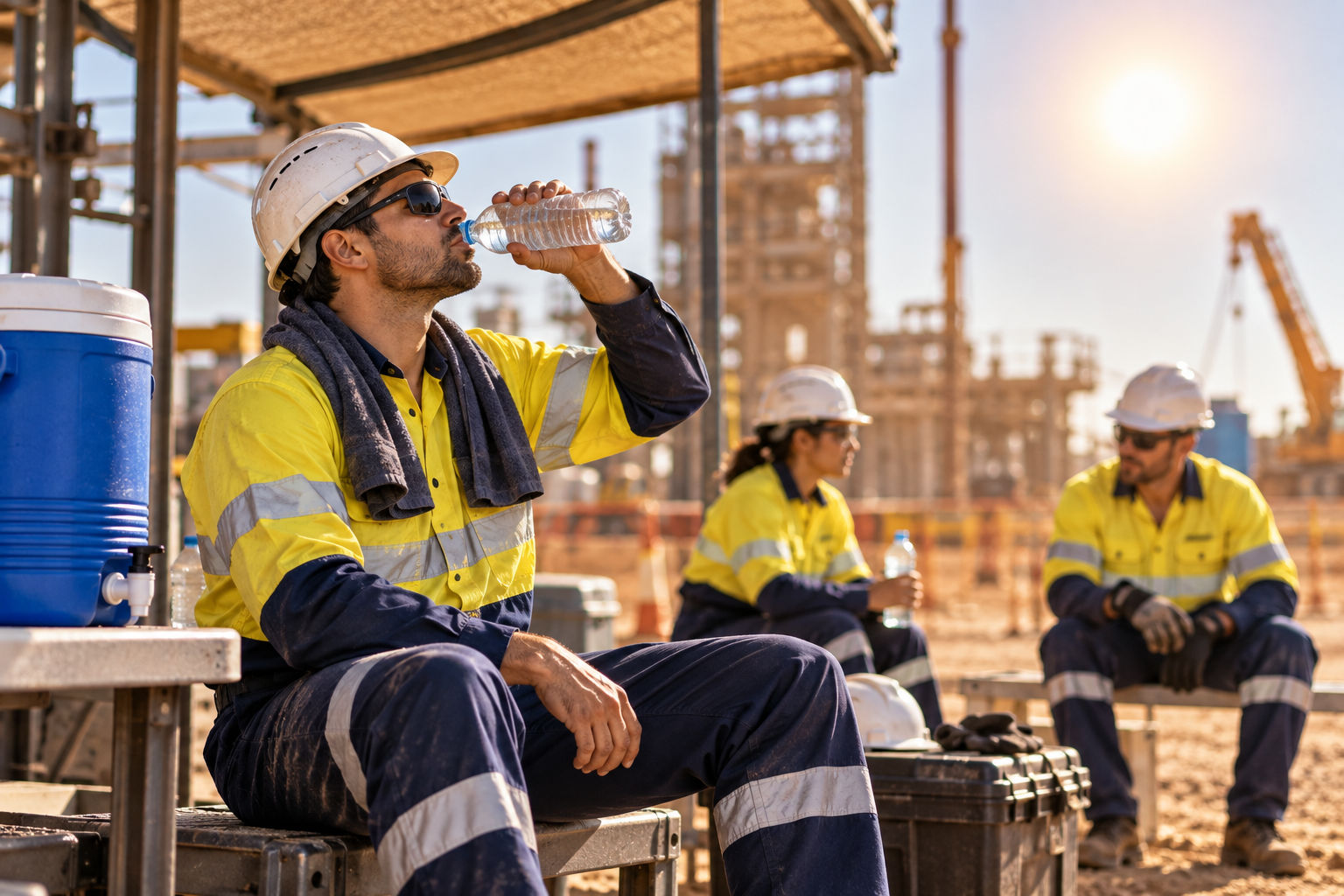
Heat stress is an important workplace safety issue in construction, manufacturing, warehousing, logistics, mining, utilities, oil and gas, maintenance and other physically demanding industries. It is not limited to workers standing outdoors in direct sunlight. High indoor temperatures, radiant heat, humidity, physically demanding tasks and protective clothing can all increase the amount of heat the body must manage during a shift.
Personal protective equipment can add another challenge. PPE is necessary when workplace hazards cannot be eliminated or adequately controlled by other measures, but some protective equipment can restrict airflow, reduce evaporation of sweat or add weight and insulation. Chemical protective suits, flame resistant workwear, high visibility garments, gloves, respirators and other safety PPE may therefore need to be considered when assessing workplace heat stress.
An effective heat stress management plan does not simply tell workers to drink more water. It considers the work environment, physical workload, clothing and PPE, humidity, radiant heat, air movement, worker acclimatisation, rest opportunities, work scheduling, supervision and emergency response.
This guide explains practical ways employers, safety managers, supervisors and procurement teams can reduce heat-related risk while maintaining the protective equipment required for the task.
What Is Workplace Heat Stress?
Heat stress occurs when the body is exposed to more heat than it can comfortably manage. The body attempts to maintain a safe internal temperature through mechanisms such as sweating and increased blood flow to the skin.
When heat exposure, physical activity, environmental conditions and clothing place too much demand on these cooling mechanisms, the risk of heat-related illness and fatigue increases.
Workplace heat exposure may come from several sources:
- high outdoor air temperature;
- direct sunlight;
- high humidity;
- radiant heat from furnaces, machinery or hot surfaces;
- poor ventilation;
- heavy physical work;
- limited access to rest areas;
- protective clothing and PPE;
- long shifts or extended exposure.
These factors often interact. A moderate temperature combined with high humidity, demanding work and impermeable PPE may create significant heat load even when the air temperature alone does not appear extreme.
Heat Stress Is Not Only an Outdoor Hazard
Outdoor workers receive much of the attention when discussing working in hot weather, but indoor heat exposure can also be significant.
Factories, foundries, laundries, commercial kitchens, workshops, boiler rooms, warehouses and other industrial facilities may experience high temperatures because of machinery, processes, roofs, poor ventilation or radiant heat.
Indoor workers can also be exposed to humidity and limited air movement. If heavy PPE or protective workwear is required, the body may have greater difficulty releasing heat.
This is why workplace heat stress assessments should focus on actual working conditions rather than relying only on the outdoor weather forecast.
How PPE Can Increase Heat Load
PPE protects workers from hazards, but certain equipment can reduce the body's ability to lose heat.
The level of additional heat burden depends on the type of PPE, material, coverage and work activity.
Protective Coveralls
Full-body coveralls provide valuable protection against industrial hazards, dirt, contamination and physical exposure. However, heavier fabrics and full body coverage may retain more heat than lightweight clothing.
Flame Resistant Workwear
FR garments are essential where workers face suitable heat, flame or electrical hazards. Because protection must not be compromised, employers should manage environmental heat through work organisation, breaks, hydration and other controls rather than encouraging workers to remove required FR clothing.
Chemical Protective Clothing
Some chemical protective garments provide limited permeability to air and moisture. This can significantly reduce evaporative cooling and should be included in the heat stress risk assessment.
High Visibility Workwear
Hi-vis garments are necessary in many road, construction, mining, logistics and infrastructure environments. Fabric weight, ventilation, garment design and layering can influence wearer comfort during hot conditions.
Respiratory Protection
Respirators may add breathing resistance, facial heat and discomfort during demanding work. Workers should still wear the respiratory protection required for the hazard. Heat controls should be designed around maintaining correct respiratory protection.
Gloves, Helmets and Safety Footwear
Individual PPE items may seem minor, but the combined effect of head protection, gloves, footwear, eye protection and protective clothing can contribute to overall thermal discomfort.
Do Not Remove Required PPE to Solve Heat Stress
One of the most important principles in heat stress safety is that required PPE should not simply be removed because conditions are hot.
If a worker needs flame resistant clothing, chemical protection, respiratory protection, a helmet or other safety equipment, removing that protection may expose the worker to a more immediate hazard.
The better approach is to manage the heat risk using the hierarchy of controls.
This may involve:
- reducing or eliminating unnecessary heat exposure;
- isolating workers from hot processes;
- improving ventilation;
- providing shaded or cooled work areas;
- rescheduling demanding work;
- using mechanical assistance to reduce physical effort;
- providing suitable rest breaks;
- ensuring access to drinking water;
- selecting appropriate protective clothing for the hazard and environment.
Use the Hierarchy of Controls for Heat Stress Prevention
PPE should form part of a broader risk-control strategy. Employers should first consider whether heat exposure can be eliminated or reduced through higher-level controls.
Elimination
Where practicable, avoid performing particularly demanding tasks during periods of extreme heat. Some outdoor work may be rescheduled to another day or another part of the shift.
Substitution
Replace highly physical manual tasks with lower-exertion methods where suitable. Mechanical handling equipment or automated processes may reduce metabolic heat generated by the worker.
Isolation
Separate workers from heat-generating machinery, radiant heat sources or hot processes where practical.
Engineering Controls
Engineering controls may include:
- local ventilation;
- air conditioning in rest areas;
- fans where suitable;
- shading;
- heat shielding;
- insulation around hot equipment;
- mechanical handling aids;
- access to cool drinking water.
Administrative Controls
Administrative controls are especially important for working in hot weather.
Examples include:
- scheduling demanding activities during cooler periods;
- work-rest cycles;
- job rotation;
- worker training;
- heat stress supervision;
- acclimatisation programs;
- buddy systems;
- planned hydration;
- monitoring weather and workplace conditions.
Work Scheduling Can Make a Major Difference
Changing when work is performed can significantly reduce heat exposure without changing the task itself.
Outdoor construction, infrastructure, mining and maintenance teams may be able to perform heavier activities earlier in the morning, later in the afternoon or during another cooler period.
Work scheduling should consider:
- forecast temperature;
- humidity;
- solar exposure;
- physical workload;
- required PPE;
- availability of shade or cooling;
- worker acclimatisation;
- shift duration.
There should also be flexibility to modify the plan when conditions differ from the forecast.
Hydration Is Important, but It Is Not the Only Control
Access to suitable drinking water is a core part of workplace heat stress prevention. Workers performing physical work in hot environments may lose significant fluid through sweating.
However, hydration should not be used as the only control for a poorly managed hot workplace.
A strong heat stress program combines hydration with ventilation, shade, rest, work scheduling, workload management and appropriate supervision.
Drinking arrangements should also be practical. Water needs to be readily accessible near the work area. If workers have to leave a secure work zone, remove complex PPE or walk a long distance every time they need water, they may drink less frequently than intended.
Why Rest Areas Matter
A rest break is more effective when the recovery area actually allows workers to cool down.
Where possible, rest locations should provide:
- shade;
- air movement;
- cooler temperatures;
- seating;
- drinking water;
- space to safely manage PPE where appropriate.
A worker resting next to the same hot machinery or in direct sunlight may receive far less recovery benefit than someone resting in a cooler environment.
Acclimatisation and New Workers
Workers who are accustomed to hot conditions may generally tolerate heat differently from workers who have recently started, returned after an absence or transferred from a cooler environment.
Employers should consider acclimatisation when organising hot work. Gradual exposure, suitable workloads, supervision and rest opportunities can be particularly important for workers who are not accustomed to the conditions.
The issue is also relevant to contractors and temporary workers who may arrive at a site without previous exposure to the same environment.
Recognising Heat-Related Illness
Workers and supervisors should be trained to recognise potential signs of heat-related illness and respond quickly.
Possible warning signs can include:
- heavy sweating;
- dizziness;
- weakness;
- headache;
- nausea;
- muscle cramps;
- fainting;
- unusual fatigue;
- confusion or altered behaviour.
Heat-related illness can become serious. Workplace first-aid procedures should be established before hot work begins, and workers should know how to obtain assistance.
Heat stroke is a medical emergency. Sites should have clear emergency procedures and workers should follow local first-aid and emergency-service guidance.
Heat Stress and Worker Concentration
Heat exposure does not only create illness risk. Fatigue and reduced concentration can also affect general workplace safety.
A worker who is overheated or exhausted may be less able to concentrate on machinery, traffic movement, electrical hazards, work at height or manual-handling tasks.
This means heat stress can contribute indirectly to incidents unrelated to temperature itself.
Supervisors should therefore look for changes in behaviour and work quality as well as obvious physical symptoms.
Selecting Workwear for Hot Conditions
Where the hazard assessment allows a choice between suitable garments, workwear design can influence comfort.
Consider:
- fabric weight;
- air permeability;
- ventilation features;
- garment fit;
- moisture management;
- required coverage;
- reflective tape configuration;
- task-specific certification;
- compatibility with other PPE.
The objective should not be to choose the lightest garment available regardless of protection. It should be to achieve the necessary protection with an appropriate garment for the environment and task.
Heat Stress and FR Workwear
Workers in oil and gas, electrical utilities, petrochemical operations and other high-risk environments may need flame resistant workwear even in very hot conditions.
The protective requirement remains essential.
Heat risk should therefore be controlled through the overall work system. Employers can consider work scheduling, cooled rest areas, shade, hydration, workload management and suitable FR garment designs that meet the required protective specification.
Procurement teams should avoid treating comfort and protection as completely separate issues. A garment that workers find extremely uncomfortable may affect how consistently it is worn, but comfort improvements must never compromise the required protection.
Heat Stress in Chemical Protective Clothing
Chemical splash and contamination risks may require coveralls or suits with limited breathability.
These garments can create a significant thermal burden during physical work. Sites using this type of PPE should consider shorter work periods, controlled rest periods, cooler recovery areas, hydration and task planning.
Where several types of chemical protective clothing can satisfy the hazard assessment, comfort and thermal burden may also be considered as part of product selection.
Construction and Civil Work
Construction workers can be exposed to direct sunlight, reflected heat, heavy physical workloads and mandatory PPE at the same time.
Practical heat stress controls may include:
- temporary shade;
- earlier start times where appropriate;
- planned breaks;
- cool drinking water;
- mechanical handling assistance;
- rotation of physically demanding tasks;
- monitoring weather conditions;
- heat stress toolbox talks.
Manufacturing and Engineering
Factories may experience significant indoor heat even when outdoor weather is moderate.
Heat-generating machinery, furnaces, welding, poor airflow and protective clothing can combine to create risk.
Engineering measures such as shielding, insulation and ventilation can be particularly valuable because they address the heat source rather than relying solely on worker behaviour.
Warehousing and Logistics
Large warehouses can become extremely warm, particularly where roofs absorb solar heat or loading areas are open to outside conditions.
Workers may also perform repetitive manual tasks while wearing hi-vis garments, footwear and other PPE.
Employers should consider airflow, drinking-water access, workload, break areas and heat exposure around loading docks and yards.
Mining, Oil and Gas and Utilities
Remote industrial operations may combine high ambient temperature with heavy protective clothing, long shifts and physically demanding tasks.
Heat stress management should be integrated into site planning rather than treated as an informal summer issue.
This can include:
- formal heat risk assessments;
- environmental monitoring;
- work-rest planning;
- supervisor responsibilities;
- worker training;
- emergency procedures;
- hydration and recovery facilities;
- PPE selection appropriate to both the hazard and the environment.
Workplace Heat Stress in Australia
Australian workplace safety guidance treats working in heat as a risk that should be identified, assessed, controlled and reviewed.
For industrial businesses, the important point is that heat risk should not be managed using one simple temperature number. The work itself, humidity, air movement, radiant heat, PPE, workload and worker circumstances can all influence risk.
Businesses should also consider requirements and guidance from the relevant state or territory regulator for their particular workplace.
Workplace Heat Stress in India
Heat exposure is also an important occupational safety issue across India, particularly for construction, manufacturing, mining, logistics, utilities and other labour-intensive industries.
Indian labour authorities have promoted measures such as rescheduling working hours, improving drinking-water access, providing ventilation and rest areas, allowing flexible schedules and building worker awareness of heat illness.
For employers operating in India, heat stress management should be integrated into occupational health and safety planning and adapted to local seasonal conditions.
Building a Practical Heat Stress Management Plan
A workplace heat stress management plan can include the following steps:
- Identify jobs and locations where workers may be exposed to heat.
- Review environmental conditions, including temperature, humidity, radiant heat and airflow.
- Consider physical workload and duration.
- Assess the effect of required PPE and workwear.
- Implement higher-level controls wherever reasonably practicable.
- Provide accessible drinking water.
- Establish suitable rest and recovery areas.
- Plan work-rest cycles where necessary.
- Train workers to recognise heat-related symptoms.
- Establish supervisor responsibilities and escalation procedures.
- Prepare emergency and first-aid arrangements.
- Review controls when conditions, tasks or PPE change.
PPE Procurement Checklist for Hot Work
Safety and procurement teams should ask more than whether a product meets a required standard.
For work in hot environments, consider:
- Does the PPE provide the protection required for the hazard?
- How much of the body does it cover?
- How breathable is the material where breathability is permitted?
- How heavy is the complete PPE system?
- Will several PPE items be worn together?
- Does the garment allow suitable movement?
- Are ventilation features possible without compromising protection?
- How long will workers wear the equipment continuously?
- Can workers safely remove or manage the PPE during breaks?
- Are replacement products consistently available?
Common Heat Stress Management Mistakes
Relying Only on Temperature
Temperature is important, but humidity, workload, radiant heat, air movement and PPE can significantly change the risk.
Relying Only on Hydration
Water is important, but hydration alone cannot compensate for excessive heat exposure.
Ignoring PPE Heat Burden
A worker wearing full protective clothing may face a different heat load from a worker doing the same task in lighter clothing.
Waiting for Workers to Report Serious Symptoms
Supervision and early recognition are important. Workers should be encouraged to report heat symptoms before they become severe.
Using the Same Work Plan Every Day
Conditions change. Heat controls should be flexible enough to respond to weather, workload and site conditions.
Removing Required PPE
Removing necessary PPE can expose workers to other serious hazards. The correct response is to improve the heat controls around the task.
How Triotex and PPE CART Support Hot-Weather PPE Programs
Triotex develops and manufactures industrial workwear and protective garments for demanding sectors including construction, manufacturing, oil and gas, utilities, mining and engineering.
PPE CART supports workplace buyers with access to PPE, workwear, safety footwear and other industrial safety products.
For businesses operating in hot environments, the most effective PPE program considers both hazard protection and real working conditions. Product selection, garment design, worker comfort, durability and compatibility should form part of the broader workplace risk assessment.
Frequently Asked Questions
Can PPE cause heat stress?
PPE does not automatically cause heat stress, but some protective equipment can increase thermal load by adding insulation, weight or reducing evaporation. Its effect should be considered as part of the overall heat risk assessment.
Should workers remove PPE when they become hot?
Workers should not remove PPE that is required to protect them from workplace hazards unless this can be done safely under the site's procedures. Heat risk should instead be managed using suitable controls, breaks and work planning.
Is there one temperature at which work must stop?
Heat risk cannot generally be assessed from temperature alone. Humidity, air movement, radiant heat, physical workload, PPE and other factors can affect the level of risk. Workplaces should follow applicable local laws, regulator guidance and site procedures.
What are common heat stress controls?
Common controls include shade, ventilation, cooler rest areas, drinking water, rescheduling demanding work, reducing physical workload, work-rest cycles, worker training and suitable PPE selection.
Can heat stress happen indoors?
Yes. Factories, warehouses, workshops and other indoor workplaces can expose workers to significant heat from machinery, poor ventilation, radiant heat, humidity and physical work.
Why should PPE be included in a heat stress assessment?
Some PPE changes how easily the body can lose heat. The combined effect of protective clothing, respirators, helmets, gloves and footwear may therefore influence the worker's total thermal load.
Conclusion
Heat stress prevention requires more than reacting to very hot days. It should form part of routine workplace risk management wherever workers perform demanding tasks in warm environments or wear protective equipment that can increase thermal load.
The strongest approach combines hazard control, ventilation, shade, work scheduling, hydration, recovery periods, supervision, worker training and appropriate PPE.
PPE remains essential where hazards require it. The goal is not to reduce protection in hot weather. The goal is to design work so employees can remain properly protected without being exposed to unnecessary heat risk.
For safety managers, procurement teams and industrial employers, considering heat stress when selecting workwear and PPE can improve comfort, compliance and the overall effectiveness of the workplace safety program.
About the author
Pujan Thakkar is building Triotex and PPE CART with a focus on industrial workwear, PPE, product strategy, manufacturing, growth, and partnerships. He writes about FR workwear, hi-vis standards, white label manufacturing, and practical supply programs for industrial buyers.